Chaos Monkeys: Obscene Fortune and Random Failure in Silicon Valley by Antonio Garcia Martinez
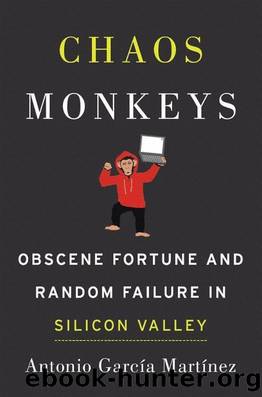
Author:Antonio Garcia Martinez [Martinez, Antonio Garcia]
Language: eng
Format: azw3
Publisher: HarperCollins
Published: 2016-06-27T16:00:00+00:00
Between the conversations I was having in Ads and the corporate convocations I was part of, I began to think I’d entered some alternate universe, an unexpected social media Twilight Zone. So I did what I always did, which was snoop on everyone’s background via Facebook and LinkedIn to figure out the nature of this strange company I was keeping.
It was clear that nobody—and I do mean nobody—in the Ads team had ever worked at any sort of advertising company. The only exceptions were the Googlers who had possibly worked on some publisher-side technology.
This was distinctly weird, for a couple of reasons: Ad tech is an incestuous world, and every advertising product manager or engineer has a résumé filled with stints at one or another ads startup. It is also a fairly insular world, which outsiders seldom dare to enter, and from which insiders rarely leave, shackled via some odd industry loyalty to the business of turning pixels into money.
Everyone on the Ads team seemed to have been vetted for Facebook acceptability and values, but nobody (other than perhaps the aforementioned former Googlers) had any notion of what the outside ads world was like. What was weirder, everyone seemed absolutely cool with that. They didn’t know what they didn’t know, and it was a feature rather than a bug.
On the one hand, that was good, as the ads world tended to self-organize into stale patterns and product ideas: maximize the clickthrough rate, autoplay video ads for movie trailers, target “auto intenders” (i.e., people in the market for a car). It was the same old, same old everywhere. Facebook was to be a new paradigm in paid media, breaking every rule or mold. On the other hand, Christ Jesus, had anyone heard of real ads targeting based on user actions like buying something or browsing a product catalog?
Nope.
Any culture able to shut itself off from the outside world goes insane in its own unique way, and Facebook had essentially done that with its Ads team. But as on Wall Street, where even someone who knew the correct price of a security couldn’t go against the will of the market, you couldn’t question the reigning insanity. And so one went along.
Eventually, this cluelessness would reach its magnificent apotheosis in the rise and fall of a bet-the-company product called Open Graph, and its monetization twin, Sponsored Stories, and in later chapters you’ll hear plenty about both.
As I did with Twitter, though, I’ll make an explicit proviso: the statements here, and even more damning ones later, were true (or at least true as perceived by me) at the time. Tech companies, even relatively large ones, are dynamic beasts. They change quickly. Facebook’s redeeming quality—the magical tendency that has saved it in the past, and will save it in the future—is its ability to rapidly adapt to changing circumstances, or to the results of its own bold product bets. In 2011 and much of 2012, the Facebook ads product was a clunker, of unproved value
Download
This site does not store any files on its server. We only index and link to content provided by other sites. Please contact the content providers to delete copyright contents if any and email us, we'll remove relevant links or contents immediately.
Whiskies Galore by Ian Buxton(42080)
Introduction to Aircraft Design (Cambridge Aerospace Series) by John P. Fielding(33175)
Small Unmanned Fixed-wing Aircraft Design by Andrew J. Keane Andras Sobester James P. Scanlan & András Sóbester & James P. Scanlan(32835)
Aircraft Design of WWII: A Sketchbook by Lockheed Aircraft Corporation(32333)
Craft Beer for the Homebrewer by Michael Agnew(18287)
Turbulence by E. J. Noyes(8113)
The Complete Stick Figure Physics Tutorials by Allen Sarah(7424)
The Institute by Stephen King(7093)
The Thirst by Nesbo Jo(7002)
Kaplan MCAT General Chemistry Review by Kaplan(6989)
Bad Blood by John Carreyrou(6671)
Modelling of Convective Heat and Mass Transfer in Rotating Flows by Igor V. Shevchuk(6495)
Weapons of Math Destruction by Cathy O'Neil(6363)
Learning SQL by Alan Beaulieu(6345)
Man-made Catastrophes and Risk Information Concealment by Dmitry Chernov & Didier Sornette(6138)
Permanent Record by Edward Snowden(5892)
Digital Minimalism by Cal Newport;(5835)
Life 3.0: Being Human in the Age of Artificial Intelligence by Tegmark Max(5618)
iGen by Jean M. Twenge(5454)
